|
|
|
Click on the buttons below to browse our site. |
One of our directors, Ian Johnstone - whom many of you will know - and his wife Ros, departed on an adventure organised by www.roarr.co.uk on March 11th, driving a 1953 Bentley R Type 3,000 miles across the Himalayas, beginning in Islamabad, and ending in Calcutta. The trip was very successful, lots of fun, and a warm welcome was received wherever they went. The car itself (blowing our own trumpets here), prepared in our own workshops, never missed a beat for the entire journey, and the package of spares taken along was not even opened until a few days prior to the end of the trip. The Bentley completed the run dent-free, returned an average of 13.3 mpg, and literally did not use a drop of water in the entire 3,000 miles, despite temperatures ranging from below freezing to 40deg C! Thanks to all the
well-wishers out there for your thoughts and comments, and we would also like to
thank Footman James for their support and insurance sponsorship. You can
learn more about their services at www.footmanjames.co.uk
They come highly recommended. The following is an account of the trip, in the words and pictures of the participants themselves.
Curry,
Tea, Retail Therapy and a 1953 R-Type Bentley.
Strange
concept ‘Freedom of the road’ when bounded by rules and regulations - but
just sometimes working in and around them; working them out; making them up;
making continuous, instant, vital decisions can be totally invigorating.
Nowhere more so than in the sub-continent and driving a classic car just
hones the experience.
A
casual trawl on the internet throws up a number of classic car rallies of
differing calibres in a variety of countries. Some competitive, some an excuse
for a few days away from home, but some offer the challenge without the
competition. In
a previous existence Ian was an overland leader/driver for several adventure
holiday companies. The main routes
covered London to Kathmandu, or London to Johannesburg usually in a 4 wheel
drive Bedford truck or a 52-seater coach. Group
sizes varied as did the role, driver/mechanic with a courier or driver, courier
mechanic all rolled into one! This
kept him occupied for ten years followed by 20 years, with Ray Arnold turning a
hobby into a business namely, the Real Car Co in Bethesda North Wales, time one
thinks to take a break! We
had always wanted to go back to India but how to do it?
Too old to do the backpacker/hippy trail, too free spirited to take a
package tour---- “eureka” a classic car rally! Serendipity,
-- an advert in “Classic Cars” for Rhythm of a Road Rally www.roarr.co.uk
driving from Islamabad in Pakistan up to Peshawar and onto Lahore crossing into
India close to Amritsar. Up into the foothills of the Himalaya through the hill
stations of Muree, and Simla taking
in Rishikesh and Dharamsala, into Nepal staying in Royal Bardia Park visiting
Pokhara and Kathmandu on up to Sikkim and Gangtok and finishing in Calcutta just
jumped off the page. Although we
had travelled in the sub-continent before Ros had never visited Pakistan and
neither of us the Indian hill stations or Calcutta. We
responded to the advertisement, ascertained what
was involved, costs, mechanical and medical back-up. Another consideration was
alternative routes if Nepal was closed as political temperatures were
fluctuating at the time of booking, June/July 2005. Dilemma:
The Car. Having
the privilege of dealing in pre-war Rolls-Royces and Bentleys we had the choice
of what was in stock. It has to be said that Ros wanted an open, pre-war,
Rolls-Royce or Bentley but the voice of reason prevailed.
There was just the car, a MKVI Bentley en-route from Australia, then it
arrived and Ros decided she could not live with the colour even if it was just
for a few weeks (it was also in such lovely, original, rust-free condition that
it was just too good to take!). Maybe we could think about something else in, or
coming into, stock. We
had experienced the sub-continent road quality albeit 20 years previously, which
meant that there were certain criteria that the car had to meet.
Safety, both personal and materialistic was a key consideration since we
had to be able to keep our spares safe, along with the pocket money and hotel
car parks are hotel car parks regardless of the star rating.
The car had to be mechanically sound with good ground clearance, a major
consideration since the speed bumps on Indian roads are not well marked and made
for big heavy trucks not private cars, also the roads may be partially made or
totally unmade. Comfort was also a
major issue since Ros fractured her spine early in 2005 so ride quality had to
be taken into consideration, a factor that superceded style and body colour! We
had a choice of a pre-war 20/25 saloon, another MKVI, an R-Type or an S2 and
five months to go before the shipping date.
The cars were to be shipped from Felixstowe to Karachi then transported
in their containers to Islamabad approximately a week before our arrival.
Clearly as we needed to prepare the car, get to know its foibles and
organise spares, a choice had to be made. Ian
decided it would have to be a post-war car for the more supple suspension to
help accommodate Ros’s back and his preference for a manual gearbox eliminated
the S2. Ros
reckoned that the larger boot of the R-Type would be more ‘retail therapy
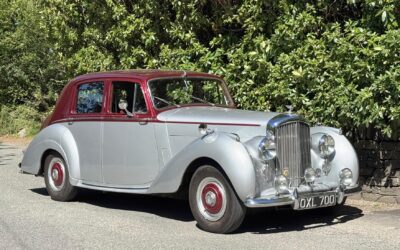
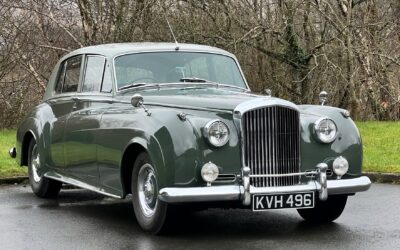
friendly’. The colour scheme of B455SP, a 1953 R-Type with manual gearbox, was
deemed acceptable by the relevant team member and the overall
mechanical/structural integrity acceptable
by the other team member. The
R-Type chosen would probably have completed the trek with minimal work, over and
above a full service, but it was deemed prudent to: change the clutch, reline
the brakes, fit a new exhaust (mild steel as easier to repair than stainless if
damaged), replace a few bearings in the front suspension and fit a slightly
heavier anti-roll bar as well as convert to negative earth to enable phone
charging etc. A good set of our favourite radial tyres were already on and the
work was completed, by fitting one
skid plate under the battery and another beneath the petrol tank. The latter
proved its worth as ‘retail therapy’ loaded in the boot combined with
vicious speed bumps caused some harmless ‘graunching’ noises from the rear
end (easily differentiated from those caused by curry overload). Oh - we also
attached towing eyes to front and rear in case rescue was needed - either by or
from us! Its
always a difficult choice to know what to take in the way of spares as
‘Sod’s Law’ has a habit of coming into its own and if you take the kitchen
sink the car probably won’t move. The sub-continent is excellent at fixing and
fabricating so we concentrated on items like plugs, points, distributor cap,
fuel pumps, gaskets and brake hoses which all fitted into a reasonable size box
with a couple of inner tubes to fill in the voids. Along
with the other participants we had a pre-departure meeting with the ROARR group
at ‘Brooklands’ just before Christmas 2005, the route was explained along
with answers to frequently asked questions and some last minute details about
shipping. We
didn’t really get much of a chance to meet our fellow travellers and Ros left
the meeting feeling somewhat reserved and concerned that she was going to be
trapped in the company of a group of classic car “anoraks” for 4 ½ weeks.
Only
the fact that we were combining the pre-departure meeting with a visit to meet
our newly-arrived grandson and some Christmas shopping in Brighton delayed her
concerns.
On our
return to North Wales we packed the car, assembled our medical kit, got our
inoculations and waited for departure, the car left the UK mid-January. We
flew out to Pakistan mid-March to collect the Bentley and set off on the rally.
Prior to departure we were watching the foreign office web-site since the
politics in that part of the world were a little flaky, Nepal was in and out of
the news, Pakistan and Afghanistan were almost complete no-go areas, sadly but
not surprisingly, some participants withdrew from the rally.
We had never done any kind of rally event before and having made all the
necessary arrangements, with domestic and work commitments, decided that we were going to go ahead. We
arrived safely, the hotel was beautiful, people
friendly and very welcoming, the Bentley was the first car to emerge out of its
steel box and started perfectly. The
drive back to the hotel was surreal, the local people expressed pleasure and
respect for the cars. There was a
diversity of cars on the rally, 1963 Triumph TR 4, 1926 Vauxhall 30/98, 1968
Ford Mustang, 1930 Morris Cowley, 1968 Volvo Amazon, 1974 NSU RO80, 1973
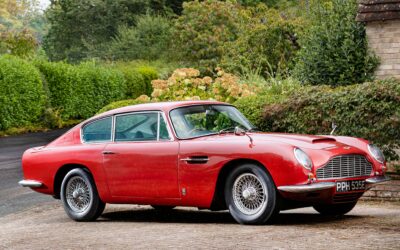
Mercedes 350SL, 1961 Chevrolet Corvette, 1967 Aston-Martin DB6,1973 Aston Martin
DBS, 1954 Jaguar XK 120, 1965 Rolls Royce SCIII, 1935 Bentley 3 ½, 1955 Bentley
Continental S1, 1953 R-Type Bentley and our R-Type.
Nationalities included Australian, German, Italian, American, and
British. The Volvo Amazon and RO80 were already veterans of the road
since they had chosen to drive from Berlin to meet the rally in Islamabad
travelling over 3,000 miles just to reach the
start. On
the Road: Pakistan After
a couple of days in Islamabad acclimatising, visiting the prime minister for tea
and waiting for the GPS systems to clear customs it was time to check out, load
up and wait for the start flag. Equipped
with GPS, road book/tulip route and maps we were sent off in style by the
Classic Car Club of Pakistan, TV crews and news reporters.
The early days of the rally involved quite short drives to allow us to
get to grips with the road book and GPS systems. But we did have some long
drives in Pakistan and we quickly remembered what driving was like in the
sub-continent. Although there are
highway codes, the key rule seems to be that everyone drives ’on the horn’. The horn takes precedence over signals flashing lights road
space anything, it is the single noise that elicits a response: It says “I am
HERE - what are you going to do about it?”
Luckily we had the foresight to fit an air horn with a switch centrally
mounted on the dashboard so that driver or passenger could operate it.
Another striking feature was that even though we were supposedly driving
on the left hand side of the road we were sharing the all the road with some
very exotic vehicles, loading techniques, drivers, cyclists and pedestrians both
human and bovine.
Motoring
through rural and urban areas brought us into very close contact with over-laden
bicycles, bullock carts, and the ubiquitous tuk-tuks.
Motorbikes or scooters carrying an entire family were a common sight but
there were relatively few private cars. We
did cause quite a stir with drivers stopping to stare and on one occasion
another driver hitting the back of a stationery vehicle!
One day we drove through four seasons in ten hours, setting off early in
light drizzle, coming onto black ice at 8,300 feet above sea level, after some
interesting sliding near precipitous drops we decided to just wait for the sun
to work its way round, and melt it.
The
scenery was breathtaking. We live on the border of Snowdonia and are used to
some stunning scenery on an everyday basis, nevertheless we were impressed.
Throughout Pakistan the standard of the hotels was excellent (many with
wireless internet!), people in the villages, towns and cities were welcoming,
friendly and very interested in the cars. India From
Pakistan we crossed into India at the Wagha border crossing and were met by
members of the Indian Classic Car Club. Our
first port of call was to visit the golden temple at Amritsar, and then relax by
the pool with a cold beer, a luxury unavailable in Pakistan.
Ever
onwards and back on the road the next day, continually winding up
into the hill stations in the foothills of the Himalayas and then
spending as long winding back down
again. Our
first view of these magnificent mountains was the very peaks of the range
shining brilliant-white in a peerless turquoise blue sky, needless to say we had
to pull over for a photo-stop.
Climbing
up to the hill stations is a laborious business but not nearly as bad as
undertaking the trek on foot, horseback or local transport!
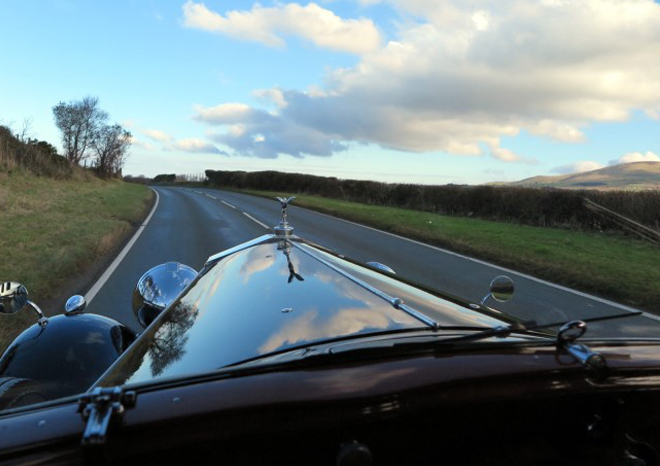
The R-type just swallowed the miles, the gradients, the hairpin bends,
and delivered us safely at our destination without a wheeze.
Driving up to the hill stations, and then back down to the plateau
involved some serious twisting and turning, on one bend we had pulled over to
admire the view, not a vehicle within sight or earshot, purring around the bend
came Pete Heller’s R-Type. Nepal Our
sojourn in the hill stations complete for the time being, we continued on
towards the Kingdom of Nepal, fortunately for us anti-royalist/rebel activity
had briefly quietened and we were able to enter the country so very recently in
turmoil. We were advised to keep
our petrol tanks as full as possible because of fuel shortages.
Crossing the border from India into Nepal we headed towards Royal Bardia
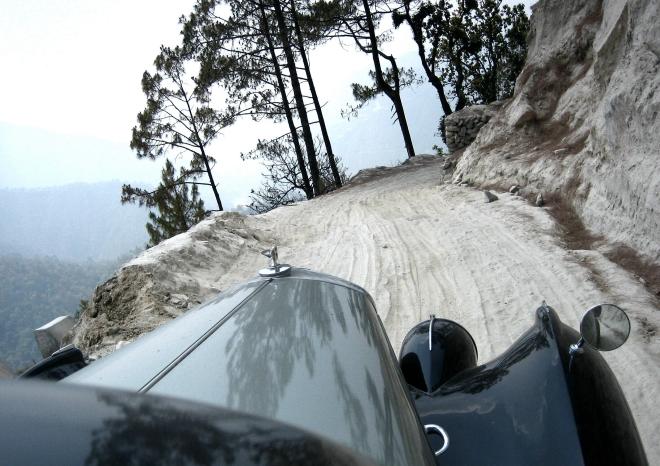
National Park the last 15 kilometres of this 300 kilometre drive were
particularly interesting as it was an unmade jeep track!
Then followed two days rest and relaxation, riding elephants, waking to
the noises of the jungle and enjoying the best bacon ever for breakfast! Also a welcome window for servicing and where necessary,
repairing the cars, in particular replacing exhaust systems on some of the
lower-slung vehicles! Onwards to the capital Kathmandu where we saw more evidence of the recent unrest and a greater army presence. The level of air pollution in the Kathmandu valley is worrying, with some local people wearing face masks whilst walking around the city. We looked up a few of our old haunts and yes, they were almost as they had been, maybe a little more developed but then we reminded ourselves that twenty years had gone by! We stayed long enough to see the main sights, indulge in some more retail therapy involving a Tibetan rug, incense and some prayer bowls then on the road and headed to another game reserve and another jeep track, on the eastern border with India. This was the longest day’s drive only 425 kilometres but due to road conditions we were advised to allow 11 ½ hours. Once again the cars and their occupants received a warm welcome and excellent hospitality from the people of Nepal despite their troubles. From
Nepal we re-entered India and began another long climb up to the tea growing
region. The road up to Darjeeling
was again spectacular, but quite frightening especially when it began to rain,
we were enveloped in cloud and mist on a single track road with a sheer drop on
one side and minimal visibility. We
just persevered, carried on driving, but very slowly as most of the local
vehicles didn’t have/use their lights. Intermittently
we emerged from the mist to catch glimpses of tea plantations and small
villages, we arrived in Darjeeling a little stressed but relieved to have
arrived safely, and again the R-type took it all in its stride. A
further bout of retail therapy was called for, in the shape of a kilogram
selection of very fresh tea from the local plantations, nothing quite like it! Whilst
in Darjeeling the weather deteriorated and news came in of doubtful viability of
the road up to Sikkim and Gangtok. We
had the choice; we could stay an extra night in Darjeeling,
begin the descent towards Calcutta or try for Sikkim.
After a night of thunder and lightning, we decided on balance to begin
the descent towards the next hotel on route for Calcutta.
Interestingly, the Bentleys all
decided to head for the plateau, we had a delightful day following the route of
the narrrow-gauge railway down from the hills to the plateau.
The rest of the group caught us up a day later having made it up to
Sikkim and down again in almost one piece.
Down
on the plains the weather became increasingly hot and humid, but the R-type
served us splendidly with the sun roof open, quarter-lights turned round to
circulate air into the cabin and with the flaps open in the foot-well we were
very comfortable. Heading down towards Calcutta travelling with the TR4, we
came upon some very new looking service stations, we stopped for lunch, three
glasses of lassi (milk curd) one coca-cola
and four masala dhosas (lace thin pancakes served with a light vegetable
curry) set us back £2! En-route
to Calcutta Ros decided to swap places with Victoria who was navigator in the
TR4 just for a short distance. It
was an interesting comparison: the TR4 scored highest on noise, and heat levels
but one certainly felt in touch with the environment, ie “the road,“ in
contrast, Victoria was seriously impressed with the armchair comfort
and softer engine note of the R-type.
We
had been aware from the start of the journey that we were sharing the road with
some phenomenally over-laden and beautifully decorated, trucks carrying various
cargoes and people from A to B. Evidence
of their demise was poignantly obvious on the dual carriageway into Calcutta
with some trucks remaining as they had stopped upside down in a drainage ditch! The buses that seemed to bear down on us at crazy speeds and
appear from nowhere, regardless of whether we were travelling though a small
village or on the open road were commonly referred to by the group as “killer
buses”. In the UK and in Europe
pedestrians use the pavement, not so in the sub-continent, the road is used by
everyone for all things, walking, shopping, selling, weaving, chopping wood,
repairing vehicles or moving sheep, goats and cattle. Throughout the entire journey we had to be aware of these
issues, we quickly ’went native’ and resorted to the horn as first defence
since it seemed to be the only thing that was reacted to. Entering
Calcutta and realising it was the end of the rally brought a whole tranche of
strange emotions. Picking up the traces of ones everyday life back home, going
back to work, but worst of all leaving the car at the docks.
The R-Type had carried us faithfully for 3,000 miles, rarely being able
to average 50 miles in an hour due to road conditions, creative highway codes
and exciting traffic, there were days when we never achieved fourth gear!
Up and down to the hill-stations along the plains, on metalled roads and
over rough cart tracks, we checked the fluid levels of the car systematically,
it needed fuel obviously and oil but it did not use any water at all for the
whole trip. By
the time we left the car at the docks in Calcutta the retail therapy had filled
the void between the tops of the front and rear seats, and if it had continued
was in serious danger of obscuring the rear window, a few yards of silk and a
sitar were the final culprits. We
flew home and expected to arrange to collect the car from Felixstowe in
approximately six weeks time. In the event the container ship was delayed by bad weather
and we didn’t see the car or the shopping for eight weeks. Unpacking was fun because we couldn’t quite remember
exactly what was packed into the boot, the back seat and any other available
space. It
had always been a ‘given’ that on our return the car would go back onto the
stock list of the Real Car Co Ltd and find a new home elsewhere.
We were surprised at the degree of emotional attachment we both had for
this sturdy, competent, car and there was some hesitation about letting it go,
but no, it was decided it was definitely going to a new home.
The R-Type now lives in Yorkshire and we trust it will continue to give
its new owners the sterling performance we enjoyed in the Himalayas. It
has to be said that the route we followed was absolutely spectacular, a
challenge for both the driver and the car, the navigator required a degree of
imagination with the road book and large doses of fortitude with the GPS.
Ros’s earlier reservations about being trapped with a bunch of classic
car anoraks were quickly and completely dispelled.
We enjoyed the company of a great group of interesting people with a
fantastic sense of humour and camaraderie.
Our Christmas card list has grown incrementally!
We mentioned at the outset we had a dilemma in choosing a suitable car
for this rally we chose well, the next dilemma for us is, where to next, which
vehicle and how to work the calendar and budget? Ian & Ros Johnstone September 2006
|